Our Story
Brother Irenee Richard, a Dominican friar and Lewiston native, once befriended a young man named Alan who had been homeless at the age of 14. When Alan tragically drowned at age 30, Brother Richard chose to honor his short life by creating a place where people experiencing homelessness would be welcomed, supported, and given the chance to rebuild. St. Martin de Porres Residence opened its doors in 1991.
Since 1991, St Martin de Porres Residence has served over 5000 individuals, which translates into over 85,000 bed nights for individuals experiencing homelessness. On average, 26% or 1335 individuals succeeded in finding permanent housing.
St. Martin de Porres
St. Martin de Porres’s story is one of humility, healing, and radical charity — a life lived entirely for the poor, the sick, and the forgotten.
St. Martin de Porres was born December 9, 1579, in Lima, Peru to a Spanish nobleman, Don Juan de Porres, and Ana Velázquez, a freed Black woman of African and Indigenous descent. Because of his mixed-race identity, his father initially refused to acknowledge him, and Martin grew up in deep poverty with his mother and sister.
From childhood, Martin showed unusual compassion. He often gave away food meant for his own family and spent long hours in prayer. At around age 12, Martin was apprenticed to a barber-surgeon, a profession that combined grooming with basic medical practice. There he learned bloodletting, herbal medicine, and surgical techniques, skills he would later use to care for the sick and the poor.
Because Peruvian law restricted people of African or Indigenous descent from full religious membership, Martin entered the Dominican Convent of Our Lady of the Rosary at age 15 as a donado — a volunteer who performed humble tasks such as cleaning and laundry. Despite racial barriers, his humility, charity, and extraordinary service led the Dominicans to accept him as a lay brother in 1603. Martin’s daily work included caring for the sick in the infirmary, distributing food, raising dowries for poor girls, and ministering to enslaved Africans. He also founded an orphanage and a children’s hospital in Lima.
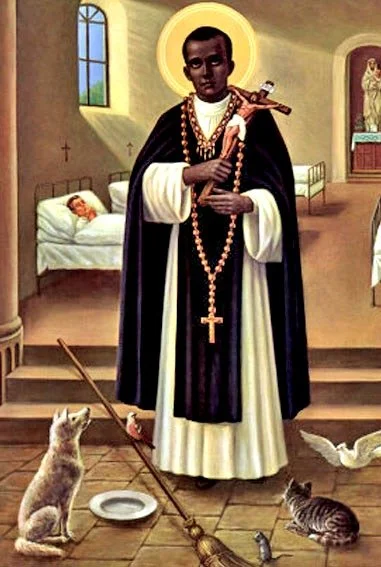
He is often depicted with a broom, symbolizing his willingness to serve in the most humble ways. Animals — dogs, cats, birds, even mice — appear in his iconography because he treated them with the same tenderness he showed people.
Many miracles were attributed to Martin during his lifetime: Healing the sick with remedies or prayer; Bilocation — appearing in two places at once; Levitation during prayer; Miraculous knowledge of events he could not have known; Communicating with animals. These accounts were widely reported by those who lived with him. One famous story describes Martin offering to sell himself as a slave to help the convent pay its debts — an act of humility that moved his superior to tears.
Martin died on November 3, 1639, at age 59. His funeral drew enormous crowds — the poor, nobles, clergy, and government officials — all united in admiration for his holiness. He was Beatified in 1837, Canonized on May 6, 1962, by Pope John XXIII, given the title Patron Saint of Social Justice, Racial Harmony, and People of Mixed Race. His feast day is November 3.
St. Martin de Porres is remembered not because he held power, wealth, or status, but because he lived the Gospel with uncompromising simplicity: He served everyone — enslaved people, nobles, the sick, the dying, animals. He broke racial barriers through holiness and compassion. He showed that charity is not an act but a way of life.
For a shelter like St. Martin de Porres Residence, his legacy is especially meaningful: he is a saint who saw Christ in the poor and treated every person with dignity.